
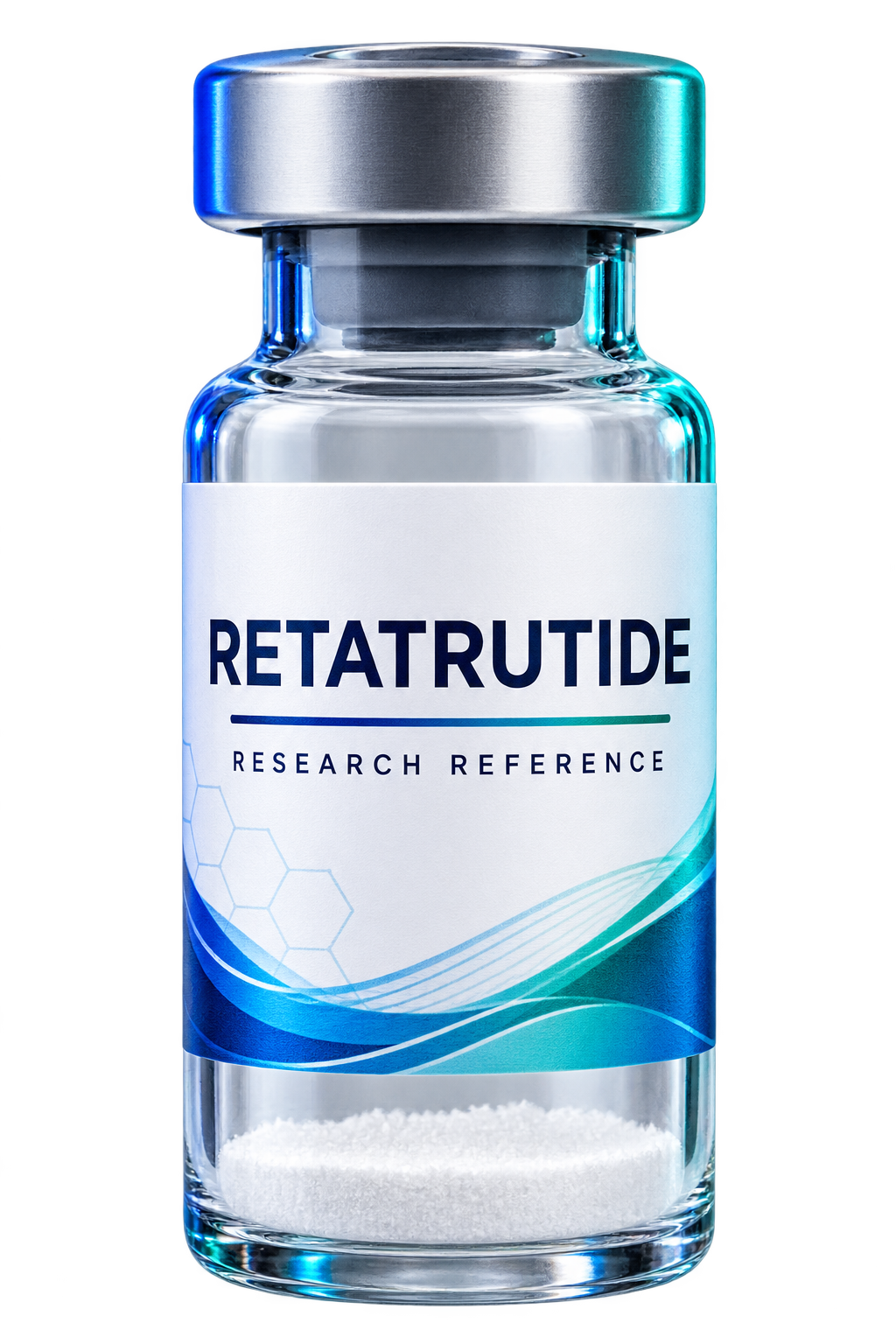
Plain-language summary: Retatrutide is an investigational peptide being studied for metabolic conditions. It is not an FDA-approved medicine, and research findings should not be treated as instructions for personal use.
What Is Retatrutide?
Retatrutide is designed to activate three receptors: GIP, GLP-1, and glucagon receptors. This “triple agonist” approach is being researched for its effects on body weight, glucose regulation, and other metabolic measures.
Research and Regulatory Status
Retatrutide remains investigational. Clinical development has progressed from phase 2 studies into phase 3 trials, but an investigational study drug is not the same thing as an FDA-approved product. Products marketed online under the name retatrutide are not validated by the existence of clinical research.
What Has Been Studied?
A phase 2 randomized trial evaluated retatrutide in adults with obesity over 48 weeks. Phase 3 TRIUMPH trials are examining weight-related and metabolic outcomes in larger groups under controlled protocols.
Early- and mid-stage findings can change as larger studies are completed. Research status, trial endpoints, and safety findings should be checked against current trial records and peer-reviewed publications.
Retatrutide Calculator and Reconstitution Math
The retatrutide calculator performs generic concentration arithmetic from a vial amount, an entered volume of BAC Water (Bacteriostatic Water) or other mixing liquid, and a user-supplied target amount. It can show concentration, calculated liquid volume, and the corresponding syringe-scale position. It does not validate the identity or quality of any material or supply a research protocol.
Retatrutide Reconstitution and Mixing Charts
A retatrutide mixing chart cannot establish that a vial is authentic or select an appropriate amount. Static charts can also hide important differences in vial amount, liquid volume, target unit, and syringe size. The calculator displays the entered values and arithmetic instead of presenting a universal preparation chart.
Retatrutide Vials and Online Products
Clinical trials use investigational material controlled under formal protocols. A vial marketed online as retatrutide is not validated by the existence of those studies. Because retatrutide is investigational, there is no FDA-approved retail retatrutide vial, prescribing label, or standardized consumer reconstitution instruction.
Retatrutide Mechanism of Action
Retatrutide is designed as a single-molecule agonist of GIP, GLP-1, and glucagon receptors. Phase 2 studies and ongoing phase 3 programs examine how this triple-receptor activity affects metabolic outcomes. Trial results describe the studied populations and protocols; they are not instructions for an unidentified product.
Retatrutide Half-Life Context
Searches for retatrutide half life generally concern pharmacokinetics and study design. Half-life does not reveal the concentration of a vial or convert syringe units into milligrams, and the calculator does not use it to generate a schedule.
Evidence and Safety Limits
Because retatrutide is investigational, there is no FDA-approved retatrutide prescribing label establishing an approved formulation or use. Participation in legitimate clinical research occurs under a formal protocol with oversight and informed consent.
Frequently Asked Questions
Is retatrutide FDA approved?
No. It is an investigational compound in clinical development.
Why does retatrutide appear in the calculator?
The selector identifies the saved calculation and report. The underlying concentration formula is generic and does not imply approval or recommend use.
Is this a retatrutide dosage calculator?
No. The calculator requires a target amount supplied by the user and returns neutral concentration and volume arithmetic. It does not choose a dose or dosing schedule.
Does the calculator provide a retatrutide mixing chart?
It calculates from the values entered instead of publishing a universal chart. No displayed BAC-water option is a recommendation.
Can retatrutide syringe units be converted directly to mg?
Only if the liquid concentration and syringe scale are known. Units alone do not identify a mass in milligrams.
Does a phase 3 trial mean a drug is approved?
No. Phase 3 research is part of evidence development. Regulatory review and approval are separate steps.
