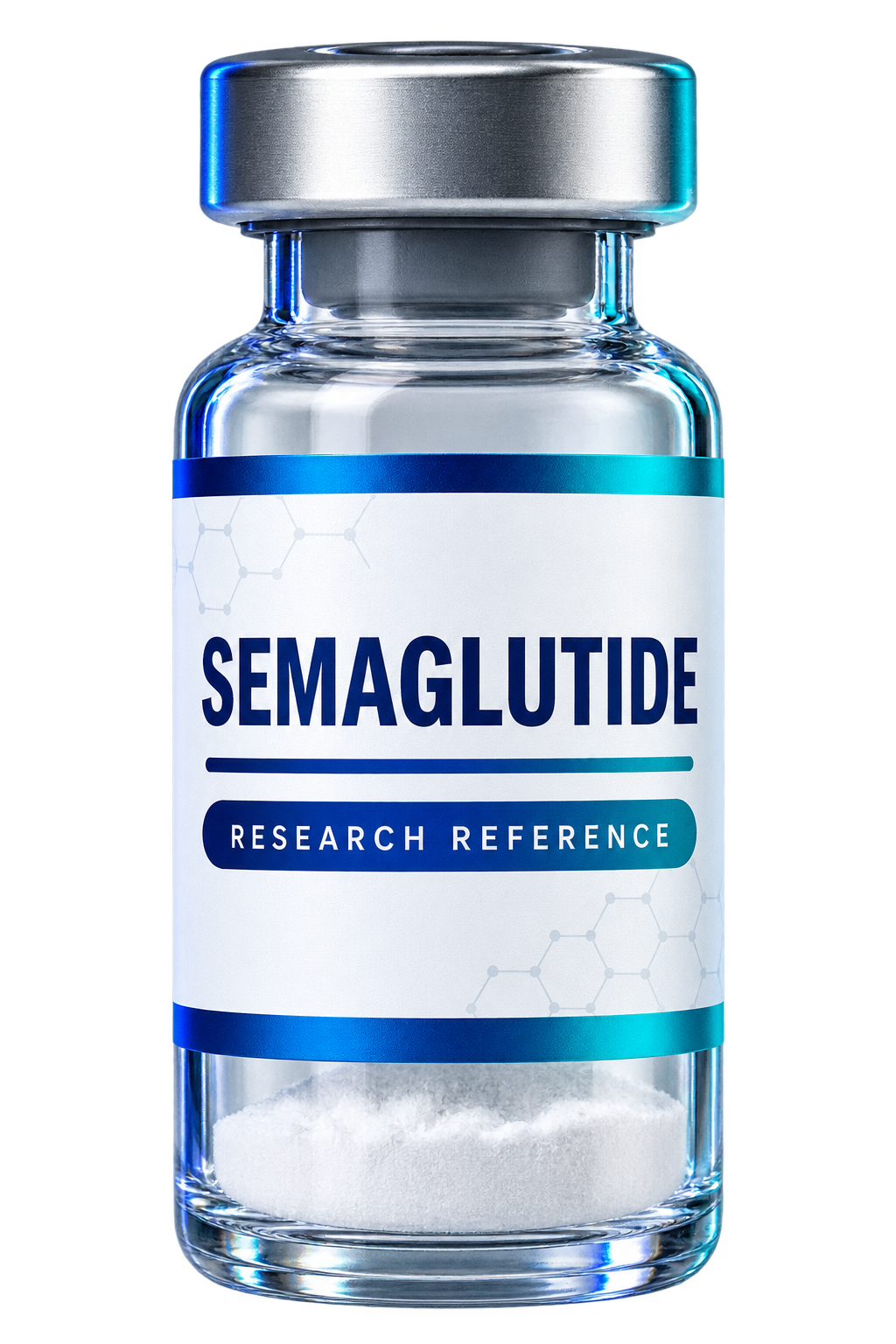
Plain-language summary: Semaglutide is a laboratory-made peptide that activates the GLP-1 receptor. It is the active ingredient in several specific FDA-approved prescription products, but that does not make every semaglutide preparation an approved product.
What Is Semaglutide?
Semaglutide is a glucagon-like peptide-1 (GLP-1) receptor agonist. GLP-1 signaling is involved in glucose regulation, appetite, and digestion. Researchers have studied semaglutide across type 2 diabetes, weight management, cardiovascular outcomes, and other metabolic questions.
Regulatory Status
The FDA has approved specific semaglutide medicines with defined formulations, manufacturers, indications, and labeling. Approval does not automatically extend to compounded products, “research” vials, or products from unidentified sources.
What Has Been Studied?
The STEP clinical-trial program evaluated semaglutide in adults with overweight or obesity. STEP 1 was a randomized, placebo-controlled trial lasting 68 weeks. Separate development programs have evaluated semaglutide for type 2 diabetes and cardiovascular outcomes.
Published averages and trial outcomes are not guarantees for an individual. Study protocols also include eligibility rules, monitoring, and other controls that a short online summary cannot reproduce.
Semaglutide Calculator and Reconstitution Math
The semaglutide calculator divides the entered vial amount by the entered volume of BAC Water (Bacteriostatic Water) or other mixing liquid. After the user enters a required target amount, it converts milligrams and micrograms as needed and reports the corresponding liquid volume and syringe-scale position. This is arithmetic—not a recommendation.
Semaglutide Mixing Chart vs. Calculator
A generic semaglutide mixing chart cannot account for every vial amount, liquid volume, unit selection, or syringe size. The calculator keeps each input visible so the result can be checked. Approved semaglutide pens and other finished products should be understood through their current product labeling rather than treated like generic research vials.
Semaglutide Units to MG and mL
Syringe units measure volume on a specified scale, not the mass of semaglutide by themselves. Converting semaglutide units to mg requires the concentration. On a 1 mL, 100-unit scale, 100 units represents 1 mL; it does not automatically represent any particular number of milligrams.
Semaglutide Mechanism of Action and Half-Life Context
Semaglutide is a GLP-1 receptor agonist. Its pharmacology and persistence are described in product-specific research and FDA labeling. Half-life information does not identify vial concentration and is not used here to generate a schedule.
Evidence and Safety Limits
Approved semaglutide products have product-specific warnings, contraindications, adverse-reaction information, and instructions in their FDA labeling. The concentration calculator cannot determine authenticity, purity, sterility, suitability, or safe use.
Frequently Asked Questions
What type of compound is semaglutide?
It is a synthetic peptide and GLP-1 receptor agonist.
Are milligrams and micrograms interchangeable?
No. One milligram equals 1,000 micrograms. The calculator converts between them, but the selected unit must match the number entered.
Does the calculator identify an appropriate target amount?
No. The required target field calculates the liquid volume corresponding to a number supplied by the user; it does not determine what that number should be.
Is this a semaglutide dosing calculator?
No. It calculates concentration and measurement volume after the user supplies the inputs. It does not provide a dose, schedule, titration plan, or treatment recommendation.
Can semaglutide units be converted directly to mg?
No. The vial concentration and syringe scale are both required. A fixed unit mark can represent different milligram amounts at different concentrations.
Does this replace a semaglutide reconstitution chart?
It performs the arithmetic for entered values and avoids assuming that every vial or liquid volume is identical. It is not a preparation protocol.
